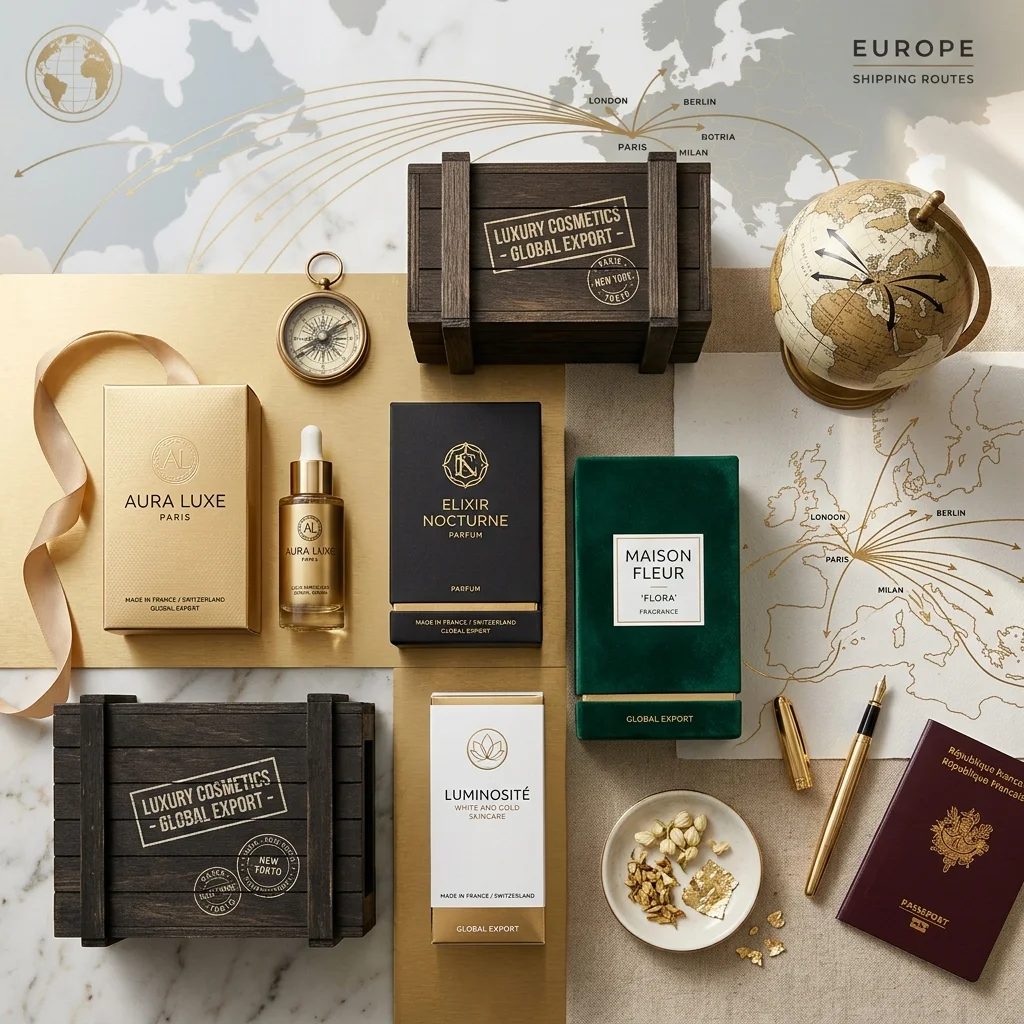
Private Label Perfumery prepares fragrance shipments and export documentation from Istanbul, Turkey according to the destination market. Alcohol-based perfume and cologne travel as dangerous goods under UN 1266, while alcohol-free roll-on perfume oil does not. Incoterms are EXW, FOB or DDP, subject to route and quotation.
One product, different market responsibilities
A shared formula or pack does not remove destination-specific obligations. The importer, Responsible Person, brand owner and manufacturer must understand who holds the product file, completes notifications, approves labels and reports safety issues.
United States
Cosmetic projects should account for applicable MoCRA facility-registration, product-listing, safety-substantiation and responsible-person duties. Alcohol-based perfume also needs a carrier-approved dangerous-goods pathway.
MoCRA was enacted in 2022 and its duties are not one-off. Facility registrations renew every two years and the cosmetic product listing information is updated annually, so a US launch creates a recurring obligation rather than a single filing. Registration is also not approval: listing a product with the agency records data about it, it does not authorise the formula. Deciding early who holds the responsible-person duty — the brand, the importer or a third party — prevents that renewal cycle from lapsing unnoticed.
Great Britain
Cosmetics placed on the GB market require the appropriate Responsible Person, safety and product information work, compliant labelling and SCPN notification. Northern Ireland can follow a different route.
The independent Great Britain regime has applied since 2021, and one UK Responsible Person is identified for each cosmetic placed on the GB market. Great Britain here means England, Scotland and Wales; Northern Ireland follows a different route, so a brand selling across the whole of the United Kingdom is planning for two regimes rather than one. That distinction is a labelling and artwork decision, not only a paperwork one, and it is cheaper to settle before cartons are printed.
European Union
Cosmetic projects require an EU Responsible Person, safety assessment, Product Information File and CPNP notification. Room fragrance products may instead trigger CLP, UFI and poison-centre duties depending on classification.
Regulation (EC) No 1223/2009 is the core EU cosmetics regulation and Article 13 establishes the main CPNP notification route. One EU-established Responsible Person is designated for the marketed cosmetic and named on the pack. Notification is not approval: it records product data before market placement and does not replace the safety report or the product information file. Mandatory particulars appear in the language required by each member state where the product is sold, so the country list — not the formula — determines how many artwork variants a launch needs.
Shipment planning
Incoterm, palletisation, dangerous-goods status, transport labels, commercial documents and importer readiness should be agreed before production release.
Quotations are issued EXW, FOB or DDP depending on the route. The Incoterm is not a formality: it decides who clears the goods, who carries the freight cost and at what point the risk transfers. A DDP price and an EXW price for the same pallet describe very different commitments, so the Incoterm and the named place belong in the brief rather than in the final negotiation.
Market requirements side by side
| Market | Framework | Notification route | Local role required |
|---|---|---|---|
| United States | MoCRA, enacted 2022 | Facility registration and product listing | Responsible person named for the product |
| Great Britain | Independent GB regime since 2021 | SCPN | UK Responsible Person |
| European Union | Regulation (EC) No 1223/2009, Article 13 | CPNP | EU-established Responsible Person |
Northern Ireland is not covered by the Great Britain row and follows a different route. Room fragrance and candle projects may fall outside the cosmetics frameworks above and into CLP, UFI and poison-centre duties instead, depending on how the finished product is classified.
Alcohol-based perfume in transport
Perfume and cologne are alcohol-based, which places them in the dangerous-goods category for transport. This is a carrier and route question rather than a formulation one: the packing, the transport labels and the declaration have to match what the carrier has approved, and air freight, sea freight and road freight do not share the same limits. A project that assumes air freight and discovers the limit late loses time it did not budget for.
Oil-based roll-on perfume oil does not carry the same constraint, which is one reason brands shipping into distant markets sometimes lead with that format. The classification for room fragrance, candles and car fragrance follows the approved formulation and is confirmed at feasibility rather than assumed from the product category.
Documents that travel with the shipment
Turkey and the European Union operate a customs union covering industrial goods, and finished cosmetics fall inside it. In practice the movement certificate accompanying the consignment is what a European importer presents at entry. Whatever the destination, the commercial documents have to agree with each other and with the goods actually loaded — a mismatch between the certificate, the invoice and the packing list is resolved at the border rather than afterwards.
The exact document set depends on the destination and the route, so it is agreed with the freight forwarder before the first order ships rather than assembled once the pallets are ready.
What stays with the brand
A manufacturing agreement should state plainly what the supplier provides and what remains with the brand, importer, distributor or Responsible Person. Formula documents, component declarations, quality records and transport data serve different purposes and are not interchangeable. Private Label Perfumery coordinates projects from Istanbul and does not act as the Responsible Person in the destination market; that role is held by a person or company established there.
Frequently asked questions
Does registration or notification mean the product is approved?
No. US listing, GB SCPN and EU CPNP all record product data with an authority before or around market placement. None of them reviews or approves the formula, and none replaces the safety assessment or the product information file.
Can one dossier serve the United States, Great Britain and the European Union?
The underlying safety and formulation work overlaps, but the filings, the responsible-party roles and the label requirements differ by market. The practical approach is one technical core with market-specific layers, decided from the destination list before artwork is approved.
Why does the destination list change the artwork count?
Mandatory particulars appear in the language required by each member state where the product is sold. A brand launching in three EU countries may therefore need one formula, one notification and three artwork variants.
How does the Incoterm affect the quotation?
It decides who clears the goods, who carries the freight cost and where risk transfers. EXW, FOB and DDP prices for the same pallet are not comparable figures, so the Incoterm and the named place are set in the brief.
Related pages
- Private Label Perfume Manufacturer for the United States
- Private Label Perfume Manufacturer for the United Kingdom
- Private Label Perfume Manufacturer for Europe
- Dangerous Goods Shipping for Alcohol-Based Perfume
- EU Cosmetics Compliance for Perfume Brands
- Quality and Documentation
- Fragrance Product Formats
- Manufacturing Cost and MOQ
Send an export brief
Include the destination markets, the estimated quantity, the product format, the Incoterm and named place, and whether the Responsible Person or importer has already been appointed. Open items are confirmed during feasibility rather than treated as settled.
Discuss an export project